


About this textbook
Every cell operates under the same physical principles that govern the universe. Thermodynamics explains how energy transformation, dissipation, and regulation determine cellular function.
This 35-page textbook develops a coherent framework linking thermodynamic laws to mitochondrial physiology and clinical relevance. Designed for advanced readers, it progressively connects physical principles to real biological processes.
Inside the textbook (10 chapters)
Chapter 1: The Three Laws of Thermodynamics — The Universal Rules of Energy
Chapter 2: Mitochondria as Thermodynamic Engines — Architecture and Coupling
Chapter 3: Free Energy (ΔG) — The Cellular Currency of Work
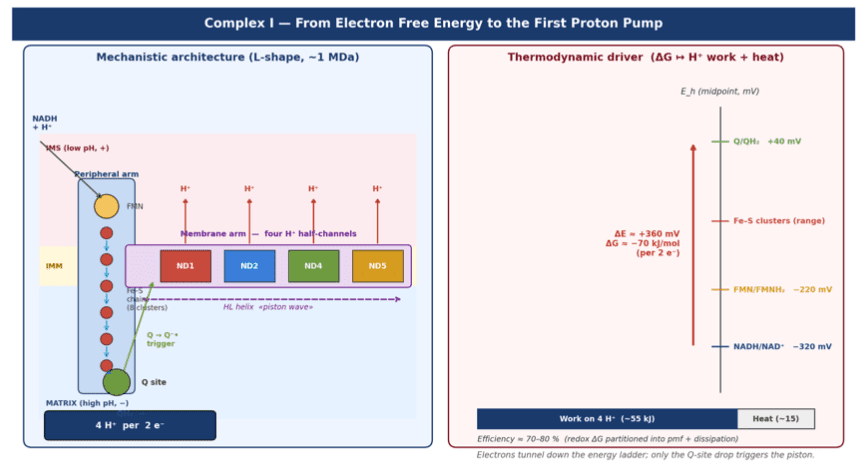
Chapter 4: The Electron Transport Chain — Where Free Energy is Harvested and Lost
Chapter 5: The Proton Motive Force and Membrane Potential (Δψ) — The Electrochemical Battery
Chapter 6: NADH, NAD+, and Redox Potential — The Nernst Equation in Biology
Chapter 7: Reverse Electron Transport, ROS, and the Danger of Hyperpolarization
Chapter 8: Thermodynamics of Inflammation — Energy Mismatch, Redox Stress, and Immune Signaling
Chapter 9: Perturbations, Drugs, and Clinical Implications
Chapter 10: Toward Integrative Medicine — Thermodynamics as a Clinical Framework
Who is this for?
- PhD students in life sciences
- Medical doctors seeking a deeper understanding of bioenergetics
- Researchers interested in redox biology and mitochondrial physiology
- Clinicians exploring integrative and systems-based approaches
Note: The full PDF is in English.