




A rational case for understanding epigenetic aging — for educated readers who want to understand, not be sold
Your DNA is not your destiny. Every cell in your body carries the same genome from birth to old age — about three billion base pairs, inherited at conception, that change very little over the course of your life. Yet identical twins, who share that genome, often diverge dramatically in how they age. One develops type 2 diabetes at fifty-five; the other runs marathons at seventy. The genetic code is identical. What differs is the way it is read.
That reading layer is the epigenome: a thin chemical script written on top of DNA that decides which genes are switched on, when, where, and how loudly. Food, exercise, sleep, sunlight, alcohol, tobacco, stress, pollution, social connection — all of these leave biochemical marks on your DNA. Those marks regulate inflammation, metabolism, immune function, and cellular repair. Over years, they accumulate into what we now call your biological age.
The fixed genome is read through a dynamic, modifiable layer — and that layer is open to intervention.
This is the central insight that makes epigenetics the most actionable tool in preventive medicine today: what you cannot change (your genes), the epigenome translates; what you can change (your lifestyle), the epigenome records and propagates. The aim of this paper is to lay out — without hype, and without minimizing what we genuinely know — the rational case for treating epigenetic measurement as a cornerstone of healthspan-oriented care.
1. The core biological principle
Genes provide the score; the epigenome conducts the performance. The genome is essentially fixed at conception. The epigenome is rewritten continuously, throughout life, by your environment and your choices. A useful image is the caterpillar and the butterfly: same DNA, two completely different organisms, because different gene programs are switched on at different stages. In humans, the same principle applies on a slower timescale. The genes you carry at twenty are the genes you carry at seventy; their expression patterns, however, will have shifted thousands of times in response to what you ate, how you slept, how you moved, whom you loved, and what you breathed.
This implies a re-framing of disease. With the exception of true monogenic disorders, most chronic diseases — cardiovascular disease, type 2 diabetes, neurodegeneration, many cancers — are not primarily genetic in origin. They are epigenetic and metabolic. Their roots lie in decades of accumulated cellular wear, written in methylation patterns and chromatin states long before any symptom appears. If we can read that wear, we can act on it before it becomes pathology.
2. Molecular mechanisms — how the epigenome writes, reads, and erases
Four mechanisms do the bulk of the epigenetic work:
- DNA methylation. A methyl group (–CH3) is added to specific cytosine bases — mostly at sites called CpG dinucleotides — by enzymes called DNA methyltransferases (DNMTs), and removed by ten- eleven translocation (TET) enzymes. Methylation in a gene’s promoter typically silences the gene; loss of methylation reactivates it. The methyl groups themselves come from S-adenosylmethionine (SAM), which depends on B vitamins (folate B9, B12, B6), choline, and one-carbon metabolism. Your diet directly fuels — or starves — your methylation machinery.
- Histone modifications. DNA is wrapped around protein spools called histones. Tags on histone tails — acetylation, methylation, phosphorylation — open or close chromatin, making genes accessible or hidden. The substrates again come from metabolism: acetyl-CoA from glucose and fatty-acid oxidation drives histone acetylation; α-ketoglutarate from the TCA cycle fuels histone demethylases.
- The NAD+ / sirtuin axis. Sirtuins (SIRT1–7) are NAD+-dependent deacetylases. They erase acetyl marks on histones and other proteins, and they sit at the centre of mitochondrial biogenesis, DNA repair, circadian regulation, and stress response. NAD+ levels fall with age — by some estimates roughly half between forty and sixty — directly limiting sirtuin activity and accelerating epigenetic drift.
- Non-coding RNAs. MicroRNAs and long non-coding RNAs add a fine-tuning layer on top of the others, modulating gene expression in response to environmental cues.
The epigenome is not abstract software. It is a chemical record written by metabolic substrates produced by your mitochondria.
SAM, acetyl-CoA, NAD+, α-ketoglutarate — these are the molecular currencies that translate lifestyle into gene expression. This is exactly why GENOWME’s gene panel makes biological sense. Markers like ELOVL2 (fatty-acid elongation, a canonical aging clock CpG), AHRR (xenobiotic response, a tobacco/pollution sentinel), KLF14 (metabolic regulation), JDP2 (transcriptional stress response), SLC7A11 (redox homeostasis), and FOXK1 (muscle development and repair) sit at the intersection of metabolism, immunity, and cellular stress — exactly where lifestyle leaves its strongest epigenetic footprints.
3. Systems-level interpretation — the epigenetic clock as an integrator
In the 2010s, Steve Horvath and others discovered that DNA methylation patterns at a few hundred CpG sites predict chronological age with extraordinary precision — typically within two to three years. These predictors became known as epigenetic clocks. A second generation (PhenoAge, GrimAge) and a third generation (DunedinPACE) moved beyond chronology: they predict mortality, cardiovascular disease, cancer, frailty, cognitive decline, and the onset of age-related disease — often outperforming traditional clinical risk factors.
These clocks are not magic. They integrate the cumulative biological footprint of several long-running processes: chronic low-grade inflammation (inflammaging), the gradual decline of immune competence (immunosenescence), mitochondrial dysfunction, circadian disruption, and the cumulative wear of chronic stress — what Bruce McEwen called allostatic load. GENOWME’s stress profile measures exactly this allostatic load with thirty-two DNA-methylation markers spread across four physiological systems: metabolic, immune, cardiovascular, and neuroendocrine.
The epigenetic clock is, in this sense, a molecular dashboard of your biology — a single readout that compresses thousands of subclinical processes into one number. A fifty-year-old with a biological age of forty-two is not just aging gracefully; she is, statistically, less likely to develop type 2 diabetes, hypertension, dementia, or coronary heart disease over the next decade than a peer with a biological age of fifty-eight. That is what makes the clock different from any classical biomarker: it is a forward-looking integrator, not a backward-looking symptom.
GENOWME’s specific contribution — the so-called “horloge suisse” (Swiss clock) calibrated on a Swiss reference population (the country with the highest life expectancy in Europe) — adds two practical layers. First, eleven epigenetic biomarkers selected for their lifestyle sensitivity. Second, a sensitivity analysis that compares your declared lifestyle (vegetables, activity, alcohol, tobacco) against the biological signature actually present in your DNA. That comparison is where the clinical insight lives.
4. A quantitative and thermodynamic perspective
A useful way to think about aging is in terms of information and entropy. The epigenome is, in part, an information storage system — methylation and chromatin patterns that tell each cell what to do. Over time, those patterns degrade. Methylation entropy increases: sites that should be tightly methylated drift toward partial methylation; sites that should be unmethylated drift the other way. The signal becomes noisier; the cell’s instructions become less clear.
Maintaining low-entropy epigenetic patterns is not free. Every methyl group transferred by a DNMT consumes one SAM (regenerated through ATP-dependent one-carbon metabolism). Every histone deacetylation by a sirtuin consumes one NAD+. Every chromatin remodeling event consumes ATP.
Maintaining youthful gene expression is, fundamentally, a thermodynamic battle against entropy — and that battle is fought by your mitochondria.
This explains a deep symmetry in the data. Mitochondrial dysfunction lowers NAD+ and acetyl-CoA → impairs sirtuin and chromatin function → drives epigenetic drift → accelerates biological aging. Conversely, caloric restriction, time-restricted eating, structured exercise, and quality sleep boost mitochondrial function → restore NAD+ → reactivate sirtuins → slow epigenetic aging. The same axis works in both directions, and the clock is sensitive enough to detect the swing.
The quantitative evidence has accumulated quickly:
- An eight-week diet-and-lifestyle intervention reduced Horvath DNAmAge by approximately 3.2 years versus controls (Fitzgerald et al., 2021).
- A twenty-four-month diet and physical-activity trial in postmenopausal women slowed GrimAge progression and reduced stochastic epigenetic mutations in cancer-related pathways (Fiorito et al., 2021, DAMA study).
- An eighteen-month polyphenol-rich Mediterranean (“Green-MED”) diet attenuated multiple epigenetic clocks; participants showed roughly 8.9 months of favorable difference in biological age (Yaskolka Meir et al., 2023, DIRECT-PLUS).
- A six-month multidomain intervention (nutrition + supervised exercise) in frail elders reduced PhenoAge and preserved methylation-based telomere length (Olaso-Gonzalez et al., 2026).
- A very-low-calorie ketogenic diet decelerated biological age in obese patients across three independent clocks (Izquierdo et al., 2025).
- Each one-standard-deviation increase in DunedinPACE predicts roughly 16% higher hypertension incidence (Kresovich et al., 2023) and 27% higher dementia risk (Belsky et al., 2022).
- GrimAge predicts time-to-death, time-to-coronary heart disease, and time-to-cancer with effect sizes comparable to or stronger than classical risk factors (Lu et al., 2019; Hillary et al., 2020).
These numbers matter because they are not only associations. Several are randomized controlled trials, demonstrating bidirectional plasticity: the clock can speed up under stress and slow down under intervention, within months. That is the property that turns a biomarker into a clinical tool.
5. Clinical and translational implications
For preventive medicine, this changes the practice in three concrete ways.
5.1 — From symptoms to subclinical biology
Conventional medicine is reactive: it intervenes when symptoms or lab values cross a threshold (HbA1c above 6.5%, LDL above 190 mg/dL, blood pressure above 140/90). By that point the underlying biology has been deteriorating for ten to twenty years. Epigenetic aging measures detect that deterioration before any classical threshold is crossed. They move the diagnostic window upstream — from disease to biological readiness for disease.
5.2 — From population recommendations to personalized lifestyle dose-response
Public-health guidelines are uniform: five portions of vegetables a day, 150 minutes of activity a week, no more than two standard drinks. But people respond to those inputs very differently, and uniform advice cannot tell who is responding well. GENOWME’s sensitivity analysis captures exactly this. Someone who reports drinking three drinks a week but shows the methylation signature of seven is metabolically vulnerable and needs a tighter intervention. Someone who reports moderate exercise but shows the signature of an athlete is biologically protected. The same lifestyle input yields different epigenetic outputs — and only the epigenome reveals it.
5.3 — From single biomarkers to a longitudinal tracker
Because epigenetic patterns shift within weeks to months, the clock can be re-measured to monitor whether an intervention is working. This converts vague advice (“you should eat better”) into closed-loop biofeedback: did the last six months actually move your biology? For the patient, that is the difference between abstract guidance and a verifiable result. For the clinician, it is the difference between hope and evidence.
5.4 — The lifestyle levers that move the clock
The interventions with the strongest evidence for slowing epigenetic aging are, reassuringly, the ones with strong evidence for everything else:
- Nutrition. Mediterranean and plant-rich patterns; polyphenols (green tea, olive oil, berries, herbs); adequate folate, B12, B6, and choline (the substrates of methylation); omega-3 fatty acids; minimal ultra-processed food and added sugar.
- Movement. Combined aerobic and resistance training; reduction of sedentary time; even short bouts of light activity reduce epigenetic age acceleration.
- Sleep and circadian alignment. Seven to nine hours, consistent timing, morning light exposure, restricted late-night eating. Circadian disruption shows up in epigenetic clocks within weeks.
- Stress regulation. Meditation, breathwork, social connection, time in nature — strategies that reduce chronic allostatic load, which is exactly the variable GENOWME’s stress profile measures across metabolic, immune, cardiovascular, and neuroendocrine systems.
- Avoidance of toxic exposures. Tobacco, excess alcohol, air pollution. The epigenetic signatures of these exposures are unambiguous and well validated.
- Targeted micronutrients. Folate, B12, choline, magnesium, vitamin D — the substrates of methylation and chromatin chemistry. Deficiencies are common and easily corrected.
For a clinic, this defines a clean preventive workflow: measure epigenetic age and stress signature → map the lifestyle inputs → intervene for three to twelve months → re-measure → iterate. This is the operational meaning of “precision preventive medicine”.
6. A cognitive-bias check — what not to overclaim
Daniel Kahneman’s distinction between System 1 (fast, intuitive, emotionally compelling) and System 2 (slow, analytical, evidence-weighted) is worth applying to ourselves before we apply it to patients. The longevity field is uniquely vulnerable to System 1 reasoning: “biological age” sounds magical, photogenic, and instantly meaningful — it activates hope, vanity, and fear all at once, which is exactly the configuration
that produces bad decisions and bad science. So a few honest caveats:
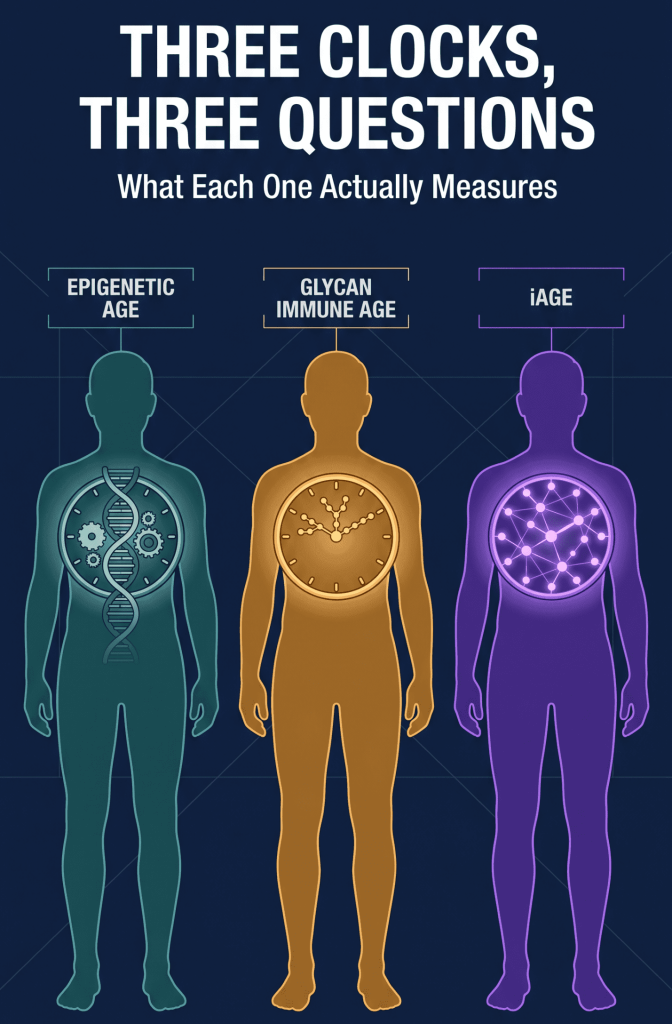
- Different clocks measure different things. Horvath’s first-generation clock tracks chronological age; GrimAge tracks mortality; DunedinPACE tracks pace of aging. They overlap but do not agree perfectly, and they capture related but distinct biology.
- Reversibility has limits. Most lifestyle interventions slow the rate of aging or shift it back by one to three years; they do not “rejuvenate” you to a younger self. Cellular reprogramming is a research frontier, not a clinical reality.
- Measurement variance matters. A clock value can shift by one to two years between measurements just from technical noise, blood-cell composition, or recent illness. Small changes should not be over-interpreted.
- Causality is partial. Clocks correlate strongly with disease risk; they do not prove site-by-site causation. New causality-enriched clocks (DamAge, AdaptAge) are beginning to address this (Ying et al., 2023).
- Lifestyle remains the lever. No supplement, peptide, or pharmacological “anti-aging” intervention has yet outperformed a structured combination of nutrition, exercise, sleep, and stress regulation in randomized trials.
The epigenetic clock is the best integrative biomarker we have for preventive medicine, and it is good enough to act on — provided we measure carefully, intervene with evidence, and track outcomes longitudinally. It is not a crystal ball. It is a high-resolution mirror.
7. Why this matters now
For most of the twentieth century, medicine waited for disease. The twenty-first century has the tools to act before disease. Genetics tells you your predispositions; the epigenome tells you how you are using them — and how to redirect them.
By measuring your epigenetic age and your stress signature today, then again in six months after a targeted lifestyle protocol, you convert “I should eat better and exercise more” into “my biology shifted from fifty-two to forty-nine — and here is what worked.” That is the closest thing modern medicine has to a longitudinal, modifiable, scientifically validated dashboard of your healthspan.
That is the rational case for placing epigenetic measurement at the centre of preventive care. It is mechanistically grounded. It is quantitatively measurable. It is biologically modifiable. It is clinically actionable. And, applied with discipline, it is honest about its limits.
The fixed code of your DNA was given to you. The way it is read is a daily decision — written one methyl group at a time.
Selected references
Horvath S, Raj K. DNA methylation-based biomarkers and the epigenetic clock theory of ageing. Nature Reviews Genetics. 2018;19:371–384.
Lu AT, Quach A, Wilson JG, et al. DNA methylation GrimAge strongly predicts lifespan and healthspan. Aging (Albany NY). 2019;11(2):303–327.
Belsky DW, Caspi A, Corcoran DL, et al. DunedinPACE, a DNA methylation biomarker of the pace of aging. eLife. 2022;11:e73420.
Fitzgerald KN, Hodges R, Hanes D, et al. Potential reversal of epigenetic age using a diet and lifestyle intervention: a pilot randomized clinical trial. Aging (Albany NY). 2021;13(7):9419–9432. Correction 2024.
Fiorito G, Caini S, Palli D, et al. DNA methylation-based biomarkers of aging were slowed down in a two-year diet and physical activity intervention trial: the DAMA study. Aging Cell. 2021;20(10):e13439.
Yaskolka Meir A, Keller M, Hoffmann A, et al. The effect of polyphenols on DNA methylation-assessed biological age attenuation: the DIRECT-PLUS randomized controlled trial. BMC Medicine. 2023;21:364.
Olaso-Gonzalez G, et al. A multidomain lifestyle intervention is associated with improved functional trajectories and favorable changes in epigenetic aging markers in frail older adults: a randomized controlled trial. Aging Cell. 2026.
Izquierdo AG, Crujeiras AB, et al. Epigenetic aging acceleration in obesity is slowed down by nutritional ketosis following very- low-calorie ketogenic diet (VLCKD). Nutrients. 2025.
Hillary RF, McCartney DL, Bermingham ML, et al. Epigenetic measures of ageing predict the prevalence and incidence of leading causes of death and disease burden. Clinical Epigenetics. 2020;12:115.
Kresovich JK, Park YM, Keller JA, et al. Methylation-based biological age and hypertension prevalence and incidence. Hypertension. 2023.
McEwen BS. Stress, adaptation, and disease: allostasis and allostatic load. Annals of the New York Academy of Sciences. 1998;840:33–44.
Chamberlain JD, et al. Development and validation of an epigenetic signature of allostatic load. Bioscience Reports. 2025.
Galkin F, Kovalchuk O, Koldasbayeva D, Zhavoronkov A, Bischof E. Stress, diet, exercise: common environmental factors and their impact on epigenetic age. Ageing Research Reviews. 2023.
Pereira B, Correia FP, Alves IA, et al. Epigenetic reprogramming as a key to reverse ageing and increase longevity. Ageing Research Reviews. 2024.
Ying K, Liu H, Tarkhov AE, et al. Causality-enriched epigenetic age uncouples damage and adaptation. bioRxiv / Nature Aging. 2023.
Yamada H. Epigenetic clocks and EpiScore for preventive medicine: risk stratification and intervention models for age-related diseases. Journal of Clinical Medicine. 2025.
Topart C, Werner E, Arimondo PB. Wandering along the epigenetic timeline. Clinical Epigenetics. 2020;12:97.
Fahy GM, Brooke RT, Watson JP, et al. Reversal of epigenetic aging and immunosenescent trends in humans. Aging Cell. 2019;18(6):e13028.
Kahneman D. Thinking, Fast and Slow. New York: Farrar, Straus and Giroux; 2011.
Drafted with reference to GENOWME (Genknowme SA, Lausanne) sample reports — BioAge & Lifestyle and Stress Overload — and to peer-reviewed primary literature retrieved via Consensus / Semantic Scholar in May 2026. The biological claims are sourced from randomized trials and reviews; the cognitive-bias caveats are the author’s own.