




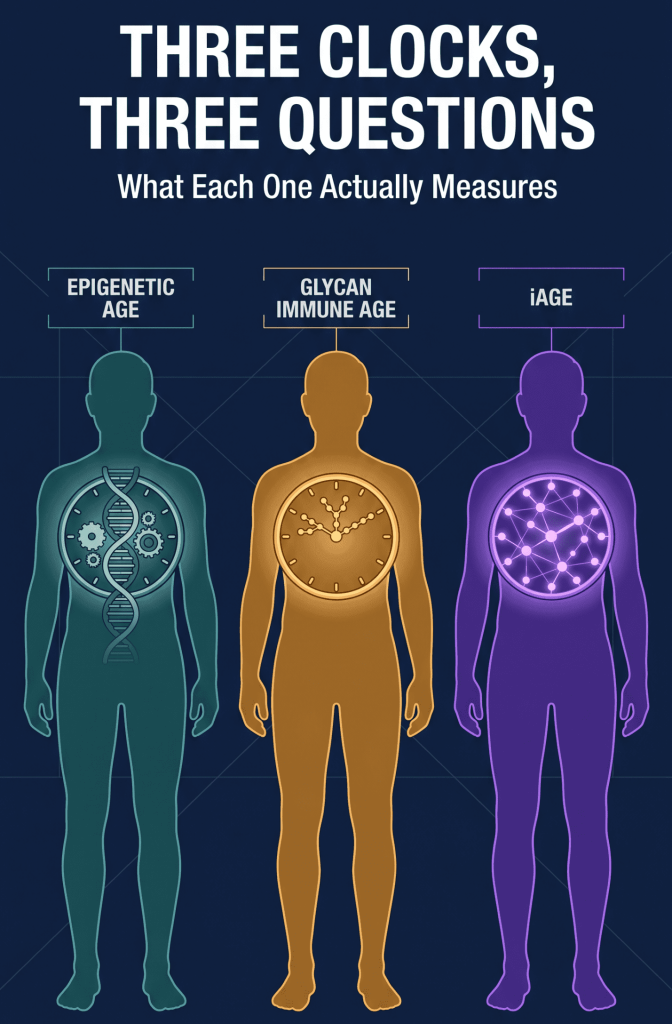
“What is my biological age?” is now one of the most common questions in longevity medicine. The honest answer is that there is no single biological age; there are several, and they measure different things. Three biological aging tests dominate the conversation: epigenetic (DNA-methylation) clocks, the IgG-glycan immune-age test (GlycanAge), and the iAge inflammatory clock. They are often discussed as if they were interchangeable. They are not. Each interrogates a different layer of your biology, on a different timescale, and each is blind to things the others see clearly.
This article unpacks what each one actually measures, mechanistically, so that a result becomes something you can act on rather than a number to worry about.
1. The core principle: three layers of the same body
Aging is not one process; it is the progressive loss of order across many regulatory layers at once. A useful way to read these three tests is to ask which layer each is sampling:
- Epigenetic clocks read the regulatory software of your cells: how your genome is annotated and switched on or off.
- IgG-glycan immune age reads the inflammatory set-point of your antibodies: whether your humoral immunity is tuned pro- or anti-inflammatory.
- iAge reads the circulating inflammatory state of your whole immune system: the cytokine and chemokine “weather” in your blood.
In other words: one measures how your genes are being regulated, one measures how your immune system is calibrated, and one measures how much your immune system is currently inflamed. A person can score “young” on one and “old” on another, and that discordance is clinically informative, not a contradiction.
2. Molecular mechanisms: what is physically being measured
2.1 Epigenetic clocks: DNA methylation drift
DNA methylation is the covalent addition of a methyl group to cytosine (producing 5- methylcytosine), almost always at CpG dinucleotides. This mark does not change the genetic code; it changes how accessible a gene is to transcription. Across the genome, methylation patterns shift with age in a partly predictable way: global hypomethylation of the genome alongside focal hypermethylation at the CpG islands of developmental and Polycomb-target genes.
An epigenetic clock is a statistical model (typically a penalized/elastic-net regression) trained to read the methylation level at a few hundred to several hundred-thousand CpG sites and output an age estimate. First-generation clocks (Horvath, Hannum) predicted chronological age. Second-generation clocks (PhenoAge, GrimAge) were trained against mortality and clinical phenotypes, so they better reflect biological risk. DunedinPACE is different again: rather than a static age, it estimates the pace of aging (biological years accrued per chronological year) and is notable for high test–retest reliability.
2.3 iAge: a deep-learning read of the circulating immunome
iAge comes from the Stanford 1000 Immunomes Project. Furman, Sayed and colleagues used deep learning on the blood immunome of 1,001 people aged 8–96 to build an inflammatory clock that tracks multimorbidity, immunosenescence, frailty and cardiovascular aging (Nature Aging, 2021). Its single strongest contributor is the chemokine CXCL9, an interferon-γ–induced T-cell–recruiting chemokine. CXCL9 rises with age, drives endothelial dysfunction and arterial stiffening, and, strikingly, silencing it reverses several aging phenotypes in endothelial cells. iAge therefore measures the systemic chronic inflammation state directly, from circulating immune proteins, rather than inferring it from a downstream mark.
2.4 Side-by-side: what each test samples
Dimension
Epigenetic clock
IgG-glycan immune age
iAge
Biological layer
Gene regulation (the epigenome)
Antibody (humoral) calibration
Whole-system inflammation
What is measured
5-mC methylation at CpG sites
Galactose/sialic-acid content on IgG Fc glycans
Circulating immune proteins (chemokines / cytokines)
Sample
Blood or saliva (DNA)
Dried blood / blood (IgG)
Blood (immunome panel)
Reads best
Pace & cumulative biological age/risk
Immune inflammatory set- point
Current inflammatory burden; cardiovascular risk
Largely blind to
Acute inflammation; immune tone
Non-immune organ aging
Stable epigenetic programming
Modifiability signal
Slow (months–years)
Medium (responds to weight/lifestyle)
Fast (reflects current state)
3. Systems-level interpretation: why the numbers disagree
Because the three tests sample different layers, discordance is the rule, not the exception, and it is where the clinical signal lives:
- A normal epigenetic age but elevated iAge and IgG-G0 suggests an active inflammatory process (occult infection, autoimmunity, visceral adiposity, poor sleep) that has not yet been “written” into the slow epigenetic layer. This is an early, reversible warning.
- An accelerated epigenetic age with quiet inflammation points instead to cumulative programming damage (the legacy of past exposures) and shifts attention to long-horizon interventions.
- Concordant elevation across all three is the strongest signal of true accelerated aging and the firmest mandate for intervention.
The immune layer is central here because inflammaging is a hub: chronic low-grade inflammation both accelerates epigenetic aging and is itself driven by immune calibration (IgG glycans) and immune output (iAge). This is precisely the immunology-first vantage point from which these tests are best read together rather than in isolation.
4. A quantitative and thermodynamic perspective
Aging can be framed as the accumulation of entropy in regulatory information. The epigenome is, in information-theoretic terms, a high-density annotation layer; methylation “drift” is the gradual loss of the fidelity of that annotation. Epigenetic clocks are effectively measuring the information loss, which is why the most reliable ones (e.g. DunedinPACE, with reported test–retest ICC values around 0.96) behave like rate meters rather than snapshots.
Inflammaging adds a thermodynamic cost. A chronically activated immune system is metabolically expensive: it shifts immune cells toward aerobic glycolysis, increases mitochondrial reactive-oxygen production, and consumes NAD+ through PARP and sirtuin activity during ongoing damage signaling. iAge and IgG-G0 are, in this sense, readouts of how much of your metabolic budget is being diverted to a low-grade, self-sustaining inflammatory state, energy that is then unavailable for repair. The practical implication is quantitative: a result is most meaningful as a trend, tracked over time against a personal baseline, not as a one-off figure compared to a population.
5. Clinical and translational implications
For a clinician, the value is not in any single score but in triangulation. A defensible interpretive workflow:
- Establish the baseline across layers: an epigenetic clock for cumulative pace, an immune-age (IgG-glycan) for inflammatory set-point, and an inflammatory clock (iAge) for current burden where available.
- Read the discordance, not just the averages: it localizes the problem to programming vs. active inflammation (see Section 3).
- Match the intervention timescale to the layer: inflammation-directed and metabolic interventions move iAge and IgG glycans within months; epigenetic pace changes over longer horizons.
- Re-test on a rational interval: fast layers (inflammation) every 3–6 months; the epigenetic layer annually, and judge success by movement against the patient’s own baseline.
This is the gap most direct-to-consumer testing leaves open: the kit returns a number, but the number needs a clinician fluent in immunometabolism to convert it into a plan. That interpretive layer, not the assay, is where biological-age testing becomes medicine.
A note on certainty. The mechanisms and figures above are drawn from peer-reviewed sources cited below. The IgG-G0 age trajectory (~20% at 25 → ~40% at 70) and CXCL9 as iAge’s top contributor are directly reported in the literature. Clock reliability figures vary by study and platform; the ICC ≈0.96 figure is reported for DunedinPACE and should be read as platform-specific, not universal.